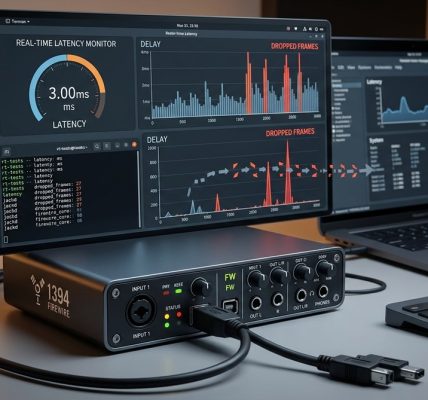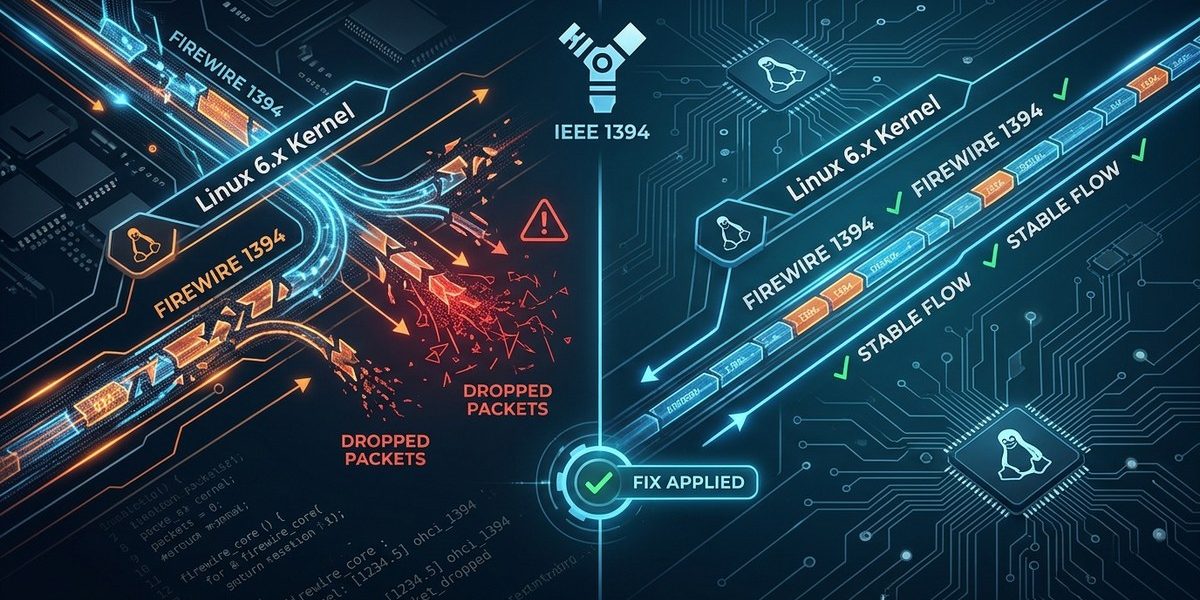

You just updated your Linux kernel to a 6.x release and suddenly your FireWire audio interface or camera is acting flaky. Dropouts, stuttering audio, or transfers that just hang. You check the logs and see messages about packet loss on the IEEE 1394 bus. This is a known headache for anyone relying on legacy FireWire gear, and it usually comes down to a few specific kernel changes that affect how the ieee1394 subsystem handles timing and buffers.
The Linux kernel 6.x series introduced tighter interrupt handling and changes to the IEEE 1394 (FireWire) driver stack that can cause packet drops under load. The fix usually involves adjusting the kernel’s real-time priority for the FireWire IRQ, increasing the DMA buffer size, or switching to the legacy `ieee1394` driver instead of the newer `firewire` module. This guide walks you through diagnosing and resolving the issue.
Why Kernel 6.x Changes Break FireWire Reliability
The FireWire protocol relies on precise timing and guaranteed bandwidth. Unlike USB, which uses a host-polling model, FireWire uses a peer-to-peer architecture with isochronous data transfers. The kernel 6.x line introduced a few changes that broke this delicate dance:
- Interrupt coalescing tweaks: The kernel now batches certain interrupts to reduce CPU overhead. For FireWire, this can delay packet processing and cause buffer underruns.
- Driver module reorganization: Starting with kernel 6.1, the FireWire driver was split and partially rewritten. The new
firewiremodule (which replaces the olderieee1394module) has different default buffer sizes and timeout values. - Power management integration: Modern kernels aggressively try to save power. FireWire devices that don’t respond to ACPI queries can get their DMA channels throttled.
If you are an audio professional running a FireWire interface from Focusrite, Presonus, or MOTU, or a video editor using a FireWire capture card, these changes hit you hardest. The result is the same: your kernel starts dropping FireWire packets.
Diagnosing Packet Drops on Your System
Before you start changing kernel parameters, you need to confirm that packet drops are actually happening. Do not guess. Use these tools to gather evidence.
Step 1: Check Kernel Messages
Run journalctl -k -f in a terminal while you stress your FireWire device. Look for lines containing ieee1394, firewire, or dma. Typical drop messages look like this:
kernel: firewire: DMA transfer error on channel 0
kernel: ieee1394: packet loss detected on bus 0
kernel: firewire: buffer underrun on node 0x12345
If you see these, you have a confirmed packet drop problem.
Step 2: Monitor DMA Transfer Statistics
Use the ieee1394 kernel interface to read raw counters. The file /sys/bus/ieee1394/devices/bus0/stats (if it exists) contains live packet and error counters.
cat /sys/bus/ieee1394/devices/bus0/stats
Look for fields like dropped_packets, dma_errors, and buffer_overruns. If any of these are increasing while you transfer data, you have your culprit.
Step 3: Test With a Known Good Workload
Use a tool like dd to transfer a large file over FireWire IP (RFC 2734) or use aplay to loop audio through your interface. Compare the error rate under idle vs. load conditions.
The Three Most Common Fixes
Once you know packet drops are happening, you can apply one or more of these fixes. They are ordered from least invasive to most invasive.
1. Switch Back to the Legacy ieee1394 Driver
The simplest fix for many users is to blacklist the newer firewire module and load the older ieee1394 module instead. The legacy driver is more forgiving with timing and buffers.
-
Blacklist the new driver:
echo "blacklist firewire" | sudo tee /etc/modprobe.d/firewire-blacklist.conf -
Load the legacy driver:
sudo modprobe ieee1394 -
Reboot and test. If this resolves your drops, you can make the change permanent by adding
ieee1394to your/etc/modulesfile.
This works well if your distribution ships both modules. Check with lsmod | grep -E 'firewire|ieee1394' to see which one is active.
2. Increase the DMA Buffer Size
If you must use the new firewire module, you can increase its internal DMA buffer. The buffer size is controlled by a kernel parameter that you can set at boot time.
-
Add this to your kernel command line in GRUB:
firewire.dma_buffers=2048 -
The default is usually 512 or 1024. Doubling it to 2048 gives the driver more room to absorb timing jitter. You can experiment with 4096 if needed.
-
Update GRUB and reboot:
sudo update-grub

  sudo reboot
3. Raise the IRQ Priority for FireWire
The kernel 6.x scheduler can deprioritize FireWire interrupt handling when the system is under load. You can use irqbalance or manual chrt commands to fix this.
-
Find the PID of the FireWire interrupt handler:
ps aux | grep -E 'firewire|ieee1394' -
Or find the IRQ number from
/proc/interruptsand set its priority withirqtopor a custom udev rule.
A more direct approach is to use chrt to set the real-time priority of the kernel thread:
sudo chrt -f -p 80 $(pgrep -f firewire)
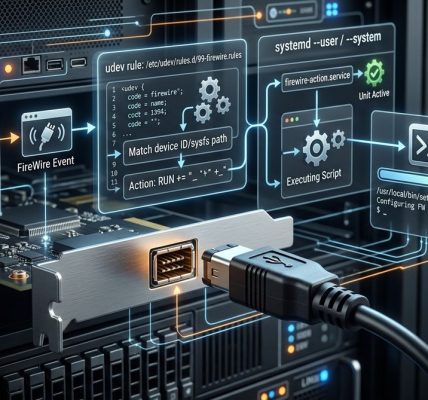
This gives the FireWire thread a high real-time priority (80 out of 99). Make this persistent by adding it to a systemd service or a startup script.
Comparison of Fix Methods
| Fix Method | Invasiveness | Effort | Success Rate |
|---|---|---|---|
| Legacy driver switch | Low | Low | High (if available) |
| DMA buffer increase | Medium | Medium | Medium |
| IRQ priority raise | Medium | Medium | High |
| Custom kernel rebuild | High | High | Very high |
The table above summarizes the trade-offs. For most users, switching to the legacy driver is the best first step. If that is not possible, raising the IRQ priority often does the trick.
What to Do If None of These Fixes Work
Sometimes the problem is not the kernel driver but the FireWire hardware itself. Older FireWire controllers (especially those based on the VIA or early TI chipsets) have known compatibility issues with Linux kernel 6.x. If you have tried all three fixes and still see drops, consider these options:
- Replace the FireWire controller: A PCIe FireWire card based on the Texas Instruments (TI) chipset is more reliable. The TI chipsets have the best Linux support.
- Use a different kernel version: Some distributions offer long-term support (LTS) kernels that backport FireWire fixes. For example, Ubuntu 24.04 LTS uses a kernel that includes patches for FireWire packet drops.
- Apply a custom kernel patch: If you are comfortable building your own kernel, you can apply patches from the Linux IEEE 1394 mailing list. These patches often address specific DMA timing issues. See our guide on building custom Linux kernel modules for FireWire hardware integration for the process.
Expert advice from a Linux audio engineer I know: “Do not assume a newer kernel is better for FireWire. I keep a 6.1 LTS kernel compiled with the legacy ieee1394 driver for my studio machine. The 6.5+ kernels introduced too many regressions for my MOTU interface.”
Preventing Future Packet Drops After Kernel Updates
You can take a few proactive steps to avoid this problem the next time you update your kernel.
- Pin your kernel version: If you have a working setup, hold that kernel version with your package manager. On Debian-based systems, use
apt-mark hold linux-image-6.x.x-x-generic. - Monitor the Linux 1394 mailing list: Subscribe to the IEEE 1394 Linux mailing list to learn about regressions before you update.
- Test updates on a spare machine: If you have a second workstation or a test VM with FireWire passthrough, test kernel updates there first.
A good companion resource is our guide on mastering FireWire device management on Linux systems, which covers udev rules and persistent device naming that can help you automate these fixes.
Staying Stable With FireWire in 2026
The Linux kernel dropping FireWire packets is a solvable problem, but it requires a methodical approach. Start by confirming the drops with kernel logs and DMA counters. Then apply the least invasive fix that works for your hardware. If you need to stay on the new firewire module, increase the DMA buffer and raise the IRQ priority. If that fails, switch to the legacy ieee1394 driver.
FireWire is not dead. It is still the best interface for low-latency multi-channel audio and certain video capture tasks. With the right kernel configuration, you can keep your legacy gear running smoothly alongside modern hardware. Do not let a kernel update ruin your workflow. Take the time to diagnose and fix it, and you will have a rock-solid system that lasts for years.